 how-to
7 Reasons Dust Sets Off Smoke Alarms
Last Updated: November 11, 2026
Quick Summary
Dust smoke alarms are usually triggered when air circulation carries dust into the sensing chamber, where it scatters light and is read as smoke. The detector is rarely broken; the air around it is the problem. Cleaning the unit and checking airflow around it stops most of these false alarms.
- An optical detector reads dust as smoke because particles scatter light in the sensing chamber.
- A detector in a direct draft from a supply vent can misfire repeatedly even after cleaning.
- Six sources account for most dust-related nuisance alarms, including construction dust and spiderwebs.
- Vacuum the cover openings with a brush attachment and low suction, then test the unit.
- Do not blow into the chamber with compressed air; it drives dust deeper into the sensor.
Table of Contents
- Can Dust Set Off a Smoke Detector? Yes, and Airflow Is Usually Why
- How HVAC Airflow and Circulation Carry Dust Into the Sensing Chamber
- 6 Common Causes of Dust-Triggered False Alarms
- Smoke Alarm False Alarms at Night: Why They Cluster After Dark
- Smoke Alarms Going Off for No Reason Hardwired: What to Check
- How to Clean a Smoke Detector Safely, Step by Step
- Reducing Dust at Its Source Before It Reaches the Detector
- When Repeated Alarms Mean It Is Time for a Professional Inspection
- Frequently Asked Questions
Can Dust Set Off a Smoke Detector? Yes, and Airflow Is Usually Why
Yes, dust smoke alarms can be set off by dust, and moving air is usually what carries it there.
A smoke alarm false alarm from dust circulation happens when particles that are not smoke enter the sensor and get read as a fire signal.
Here is the part most guides get wrong: the alarm is rarely broken. The air around it is the problem.
How Optical Sensors Read Dust as Smoke
An optical smoke detector uses a light beam and a photoelectric sensor inside a dark sensing chamber.
Dust particles are large enough to scatter light the same way smoke particles do. The detector has no way to tell them apart.
The U.S. Fire Administration home safety guidance notes that nuisance alarms are a leading reason people disable detectors, which is exactly the wrong response.
How HVAC Airflow and Circulation Carry Dust Into the Sensing Chamber
Most guides stop at "dust gets into the detector." The keyword is about circulation, so it is worth tracing the actual path.
Here is the mechanism in order.
- The return pulls room air. A return grille draws air from the room at low velocity but high volume. Any dust suspended in that room, lint, skin cells, drywall fines, pet dander, cooking aerosol, travels with it.
- The supply pushes treated air back. Supply registers discharge air at higher velocity, often aimed across a ceiling. That jet entrains nearby room air and keeps fine particles suspended instead of letting them settle.
- Pressure differences do the rest. A closed bedroom door, a running bath fan, or a kitchen exhaust hood creates a pressure imbalance. Air moves through the gaps around the detector's cover openings to equalize, and particles come along.
- The chamber traps what the airstream carries. Once inside the sensing chamber, airflow slows, and larger particles drop out of suspension onto the chamber walls and the photoelectric sensor lens.
That last step is why dust accumulation is a slow process. Each HVAC cycle deposits a thin layer.
Ventilation choices change the dose.
A detector mounted in a direct draft from a supply vent can misfire repeatedly even after cleaning, because the airflow keeps redepositing dust in the chamber.
Placement and Airflow Trade-Offs
Detector placement is a balance between early warning and dust exposure. You want the unit near sleeping areas and along the path smoke would travel, but not in the jet of a register, fan, or doorway draft. Keep it out of the direct return path and a reasonable distance from any supply register.
- Avoid corners where air stalls and dust settles
- Keep units away from ceiling fans and return grilles
- Do not mount directly above a stove or bathroom door
If ceiling fans are part of your airflow problem, our guide on preventing false alarms from ceiling fans covers the related fixes.
6 Common Causes of Dust-Triggered False Alarms
Six sources account for most dust-related nuisance alarms. Knowing which one applies to your home shortens the hunt.
- Construction dust and renovation. Sanding, drywall work, and demo send fine construction dust through the whole house.
- Insects and spiderwebs. Small insects and spiderwebs inside the chamber scatter light and mimic smoke.
- Humidity and steam. High humidity, moisture, and steam from showers or cooking condense on the sensor.
- Cooking fumes. Cooking fumes and airborne particles from frying drift into nearby units.
- A clogged air filter. A dirty air filter lets more dust pass into the ducts and the rooms.
- Poor ventilation. Weak air circulation lets particle buildup collect instead of dispersing.
Six sources account for most dust-related nuisance alarms, so knowing which one applies to your home shortens the hunt.
| Cause | What happens |
|---|---|
| Construction dust and renovation | Sanding, drywall work, and demo send fine dust through the house |
| Insects and spiderwebs | Small insects and webs inside the chamber scatter light |
| Humidity and steam | Moisture from showers or cooking condenses on the sensor |
| Cooking fumes | Fumes and airborne particles from frying drift into nearby units |
| A clogged air filter | A dirty filter lets more dust pass into ducts and rooms |
| Poor ventilation | Weak air circulation lets particle buildup collect instead of dispersing |
Smoke Alarm False Alarms at Night: Why They Cluster After Dark
Smoke alarm false alarms at night are common because conditions change after dark. Temperatures drop, windows close, and the HVAC runs longer cycles.
Closed-up homes hold more airborne dust in suspension. A detector that stayed quiet all day can trip at 2 a.m. when the heat kicks on and moves a settled layer of dust.
Removing the battery is not a fix. Clean the unit and check the airflow around it. If nighttime alarms keep repeating, the chamber may need a full cleaning.
Smoke Alarms Going Off for No Reason Hardwired: What to Check
Smoke alarms going off for no reason hardwired units usually trace back to the same dust and airflow issues, plus a few wiring checks. Work through these in order.
- Check the date. Check the manufacture date and follow the manufacturer's stated service life. An expired sensor can drift and misfire.
- Inspect the chamber. Look for dust, insects, or webs inside the cover.
- Check the interconnect. One dirty unit can trigger every alarm on the circuit.
Hardwired systems tie every detector together. That means one dusty smoke detector can set off the entire house. Cleaning the offending unit often quiets the rest.
How to Clean a Smoke Detector Safely, Step by Step
Before you clean, confirm the alarm is actually a dust nuisance and not a real event. The safe sequence is: treat every alarm as real until you have checked the room, then diagnose, then clean. Cleaning a detector that is responding to smoke or heat wastes time; cleaning one that is chirping from a low battery does nothing.
First, Diagnose Before You Clean
Work through this decision order.
- Check the room. Look and smell for smoke, scorching, or heat. If anything is present, evacuate and call for help, do not clean.
- Note the pattern. A single unit tripping during HVAC startup, a fan, or a remodel points to dust. Every unit on a hardwired circuit tripping at once points to interconnect or a shared dust event.
- Check the age. Check the manufacture date printed on the back of the unit and follow the manufacturer's stated service life. An expired sensor drifts and misfires regardless of cleaning.
- Check the battery and chirp pattern. A chirp every 30-60 seconds is usually a low-battery or end-of-life signal, not dust.
- Only then clean. If the pattern and history point to dust, proceed below.
Detector-Type Differences Matter
Photoelectric, ionization, and combination alarms do not respond to dust identically, and the manufacturer's manual governs what cleaning is approved.
- Photoelectric alarms use a light beam and sensor. Dust and insects scatter light and are a common nuisance source. The chamber is usually accessible through the cover openings for vacuuming.
- Ionization alarms use a small radioactive source and an ionization chamber (the EPA). They are generally less prone to dust scattering but can be affected by fine particles and humidity. Do not open or probe the chamber; follow the manual.
- Combination alarms pair both sensors. A dust event may trip only the photoelectric side, which can help you confirm the cause.
A common pattern is that manufacturers allow vacuuming of the cover openings but prohibit removing the cover or disassembling the chamber. Read the manual for your model before you touch anything.
The Cleaning Steps
What you'll need: a step ladder, a vacuum with a brush attachment, a soft cloth, and the manufacturer's manual.
- Isolate the unit. For a battery alarm, remove it from the bracket. For a hardwired alarm, turn off the breaker that feeds the alarm circuit before removing the unit, do not rely on the test button alone. If the alarm is part of an interconnected system, confirm the breaker controls the whole circuit.
- Read the manual first. Some brands allow cover removal; others do not. Follow their guidance exactly.
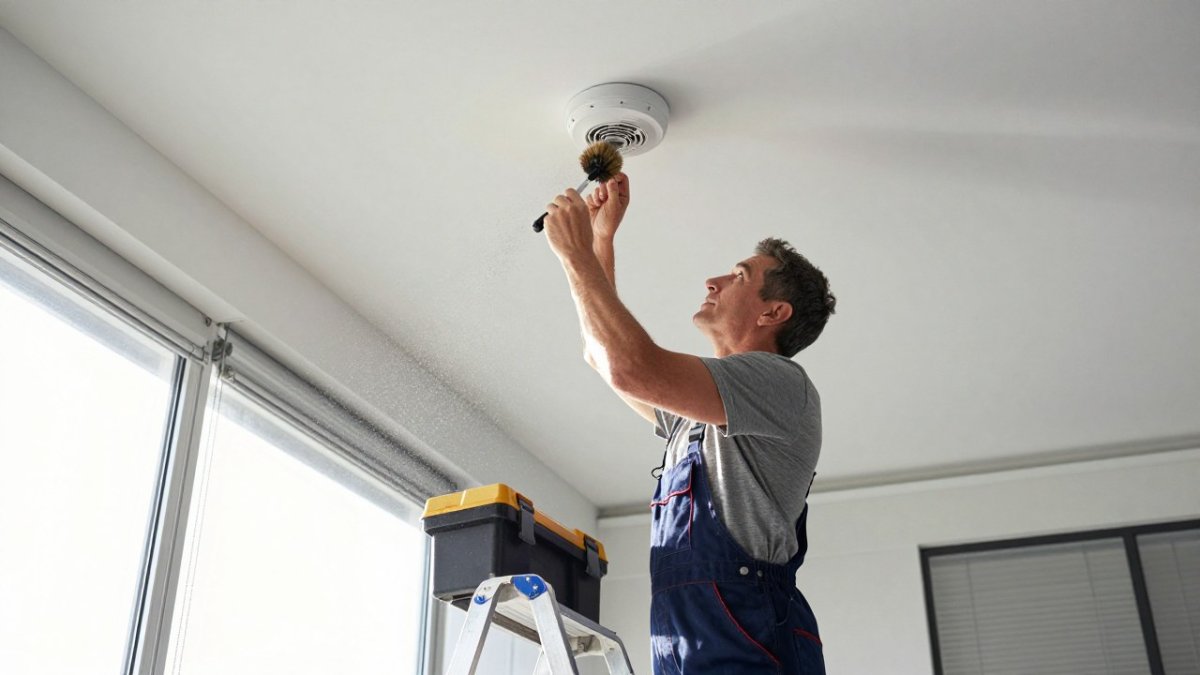
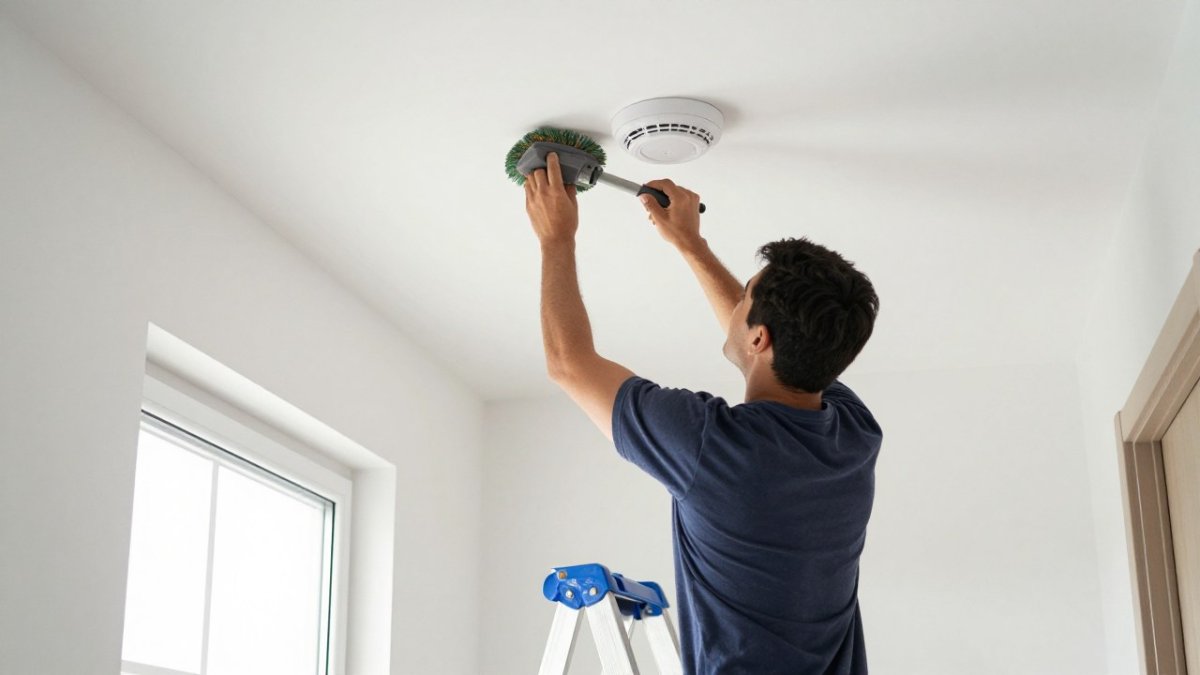
- Vacuum the cover openings. Run the brush attachment over the slots to pull dust particles out of the chamber. Use low suction and short passes.
- Wipe the exterior. Use a dry or barely damp cloth. Never spray cleaner into the unit.
- Clear the chamber openings. A quick pass with the vacuum nozzle loosens debris trapped at the intake slots.
- Reinstall and test. Restore power and press the test button to confirm it works. If the unit trips again within days under the same airflow conditions, the chamber likely needs replacement or the unit is near end of life.
What Not to Do When Cleaning a Detector
- Do not blow into the chamber with compressed air; it drives dust deeper into the sensor.
- Do not use water, solvents, or spray cleaners on the sensor or chamber.
- Do not remove the cover or disassemble the chamber if the manual forbids it.
If repeated alarms continue after a full clean and an airflow check, the unit may be faulty or past its service life. That is the point to replace it or call a professional, not to keep cleaning.
Reducing Dust at Its Source Before It Reaches the Detector
The best fix is to cut the dust before it reaches the detector. Dust prevention beats repeated cleaning every time.
Replace HVAC filters on schedule and seal return ducts. Change filters more often during renovation.
Regular maintenance matters too. Vacuum and dust high-traffic rooms weekly. Check detector placement so units sit out of direct drafts. This keeps alarm sensitivity steady and reduces nuisance triggers.
When Repeated Alarms Mean It Is Time for a Professional Inspection
Repeated alarms after cleaning can point to a failing unit or a system-wide issue.
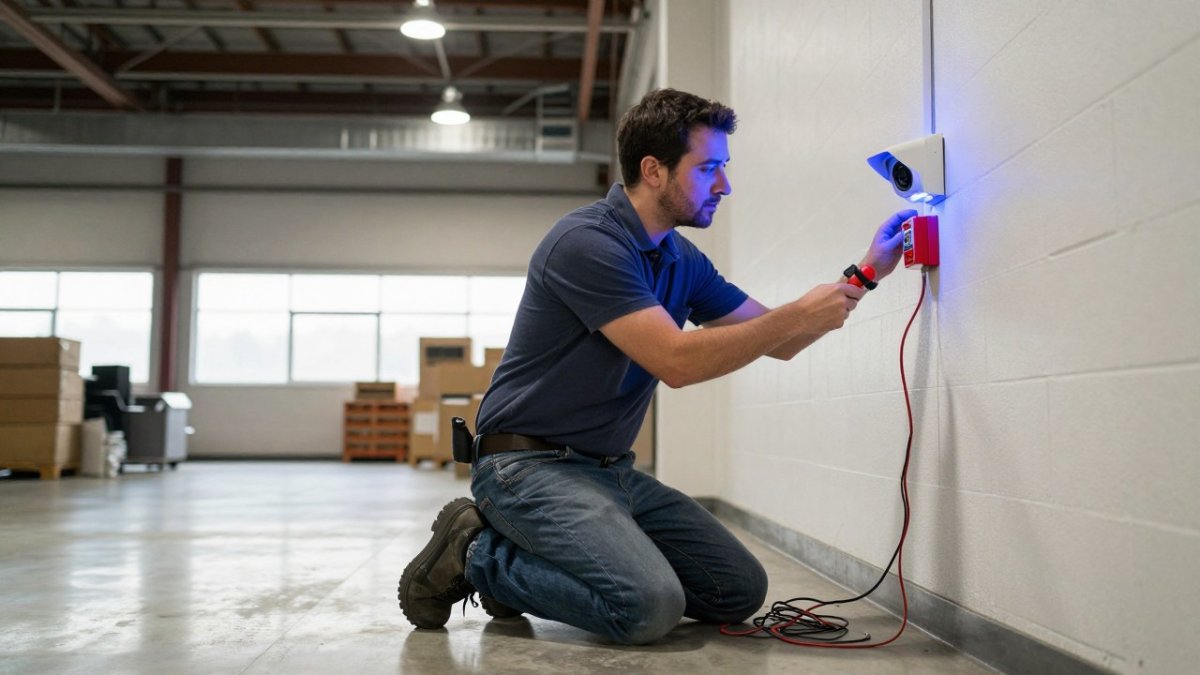
If your home or facility runs on an integrated alarm and security system, a technician can check wiring, interconnect faults, and sensor age across every unit.
Before you hire anyone, review our guide on how to evaluate security integrator service agreements so you know what support to expect. You can also see our security services or contact us to schedule an inspection.
Dust-triggered alarms are a nuisance you can fix, but repeat false alarms wear down trust in your whole system. Mt.
Frequently Asked Questions
Can dust cause a smoke detector to alarm?
Yes. Optical detectors use a light beam and a photoelectric sensor inside a sensing chamber. When enough airborne dust particles enter and scatter that light, the detector reads it the same way it reads smoke and sounds the alarm. Fine particles from construction, drywall sanding, or a dusty HVAC system are the usual culprits. Cleaning the unit and reducing dust at the source stops most of these nuisance alarms.
Can HVAC airflow carry dust into a smoke detector?
It can. Supply vents push air, and the dust it carries, across ceilings and walls. A detector mounted close to a vent or in a room with strong air circulation collects particles in its chamber faster than one in still air. Check that detectors sit a reasonable distance from supply registers, following manufacturer guidance, and change HVAC filters on schedule so the system is not redistributing dust through the home.
Why does my hardwired smoke alarm go off for no reason?
Hardwired alarms share power and interconnect wiring, so one dusty or faulty unit can set off every alarm on the circuit. Start by identifying which unit has the indicator light showing alarm origin, then vacuum that detector and check for insects or debris. If alarms persist after cleaning, the unit may be past its service life, as stated by the manufacturer, or have a wiring fault that needs an electrician or security integrator to diagnose.
How do you clean a smoke alarm without damaging it?
Turn off power at the breaker for hardwired units, then remove the detector from its base. Vacuum the cover slots and the sensing chamber opening with a soft brush attachment on low suction. Wipe the exterior with a dry or slightly damp cloth. Never spray cleaners, compressed air, or water into the chamber, and never paint over a detector. Reinstall, restore power, and test with the test button.