 ultimate-guide
Integrated Security Solutions for Modern Offices
Table of Contents
- What Are Integrated Security Solutions for Modern Offices?
- Core Components of a Modern Office Security System
- AI-Enabled Surveillance for Commercial Offices
- Best Practices for Office Security Infrastructure
- How Long Does Unified Security Integration Take?
- Key Benefits of Unified Security Systems
- Privacy, Compliance, and Total Cost of Ownership
- Frequently Asked Questions
Last Updated: September 2, 2026
What Are Integrated Security Solutions for Modern Offices?
Integrated security solutions combine video surveillance, access control, threat detection, and emergency response into a single managed platform. Rather than operating separate systems for cameras, badge readers, alarms, and fire safety, integration connects these components so they communicate in real time and respond to threats as a coordinated ecosystem.
At Mt. Major Tech, we've helped facility managers consolidate fragmented security infrastructure into cohesive systems that reduce operational complexity and response times. When your access control system knows who entered a building, your cameras are recording their movements, and your threat detection engine analyzes both feeds simultaneously, you're operating at a security awareness level that isolated systems cannot match.
Modern offices face distributed security challenges: multiple buildings, remote workers, temporary contractors, and facility teams spread too thin to monitor everything manually. Integrated solutions automate correlation, if an access event triggers at 2 AM in a restricted zone, the system alerts your team, pulls camera footage, checks badge validity, and flags anomalies in seconds rather than hours.
Core Components of a Modern Office Security System
A modern office security system integrates five primary layers: surveillance infrastructure, access control, real-time threat detection, fire and life safety, and centralized management.
Video Surveillance and AI-Enabled Analytics
AI-enabled surveillance analyzes video in real time, identifying unusual behavior, unauthorized access attempts, and potential threats before they escalate. Computer vision recognizes patterns: someone loitering in restricted areas, tailgating through secure doors, or moving inconsistently with their role. The system alerts your security team immediately rather than requiring manual review after incidents occur.
AI also reduces false alarms significantly. Older motion-detection systems triggered on shadows and reflections, exhausting your team's attention. AI distinguishes between a person entering a restricted zone and a delivery truck passing by the building. This accuracy matters because alert fatigue causes teams to stop taking alerts seriously.
Access Control and Biometric Authentication
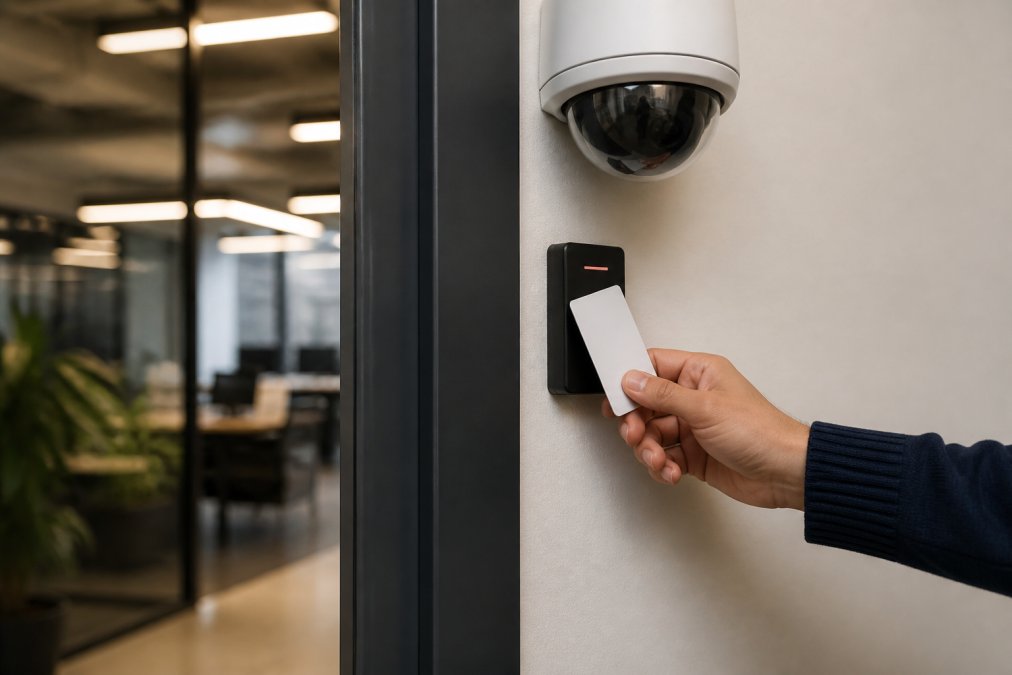
Biometric systems, fingerprint, facial recognition, or iris scanning, tie access directly to identity, eliminating credential sharing and creating auditable trails of who accessed what. For healthcare providers managing HIPAA compliance, biometric access control is particularly valuable (hhs.gov). When an employee is terminated, access is revoked immediately across all doors. Temporary contractors' access expires automatically on their end date.
Real-Time Monitoring and Threat Detection
Real-time monitoring combines data from cameras, access points, and environmental sensors to detect threats as they develop. A person using a stolen badge might pass access control, but if surveillance shows them moving toward server rooms instead of their assigned workspace, the security platform flags this as anomalous behavior. Threat detection engines use behavioral analysis to identify deviations from normal patterns, requiring integration because no single system has enough context.
Fire and Life Safety Integration
When a fire alarm triggers, an integrated system can automatically unlock emergency exits so people can evacuate without badging out, unlock stairwell doors normally restricted, and alert security to guide evacuation. Integration also improves situational awareness, if your access control system knows occupancy in each zone, first responders can prioritize rescue efforts based on where people actually are.
Centralized Management
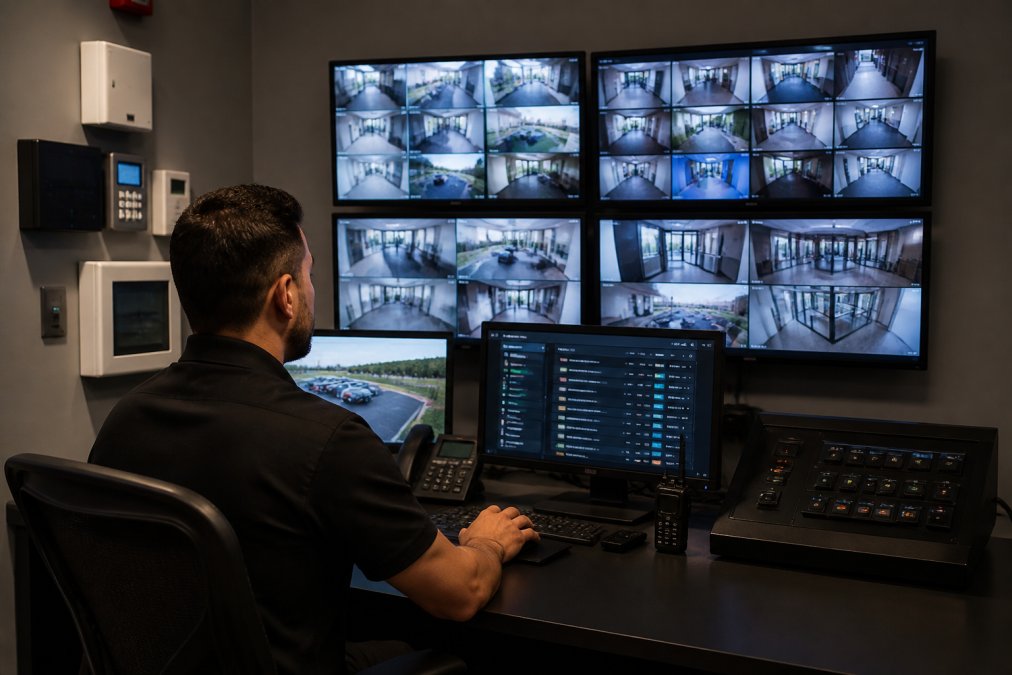
All components feed into a centralized management platform where your team logs into one dashboard instead of five different systems. Centralized management enables policy enforcement across your entire facility and is essential for organizations with distributed facilities, multiple office buildings, warehouses, or campus-style properties.
AI-Enabled Surveillance for Commercial Offices
AI-enabled surveillance actively analyzes what's happening and alerts your team to anomalies in real time. Computer vision models can detect unauthorized access attempts, loitering in restricted areas, unusual movement patterns, and object detection. For commercial offices, this means your security team focuses on genuine threats rather than reviewing hours of footage.
If someone enters a restricted server room at 11 PM, your team knows immediately. If someone tailgates through a secure door, the system flags it. The false alarm reduction is significant, AI distinguishes between normal events like cleaning crews and actual security concerns, so your team takes alerts seriously.
Best Practices for Office Security Infrastructure
Start with a security audit. Before integrating systems, understand what you have. Many organizations discover incompatible systems from different eras. A professional audit identifies what can be integrated, what needs replacement, and the optimal sequence.
Design for interoperability. Prioritize systems using open standards like ONVIF for cameras, OAuth for authentication, and REST APIs for data exchange. This prevents vendor lock-in and ensures your system can evolve.
Plan for data flow. Integration requires real-time communication between systems. Your access control system needs to tell your surveillance system when a badge event occurs. Your threat detection engine needs to query your access database. Design your network architecture to support this communication reliably.
Implement role-based access control. Define roles: frontline responders see live alerts for their assigned areas, supervisors see broader operational data, investigators access historical data. This prevents accidental misconfiguration and reduces insider threat risk.
Document everything. Document your system architecture, integration points, data flows, backup procedures, and incident response protocols. Clear documentation enables quick troubleshooting.
How Long Does Unified Security Integration Take?
Assessment and planning phase: 2-4 weeks. A professional security integrator evaluates your current systems, identifies compatibility issues, and designs the integrated architecture.
Design and procurement phase: 3-6 weeks. You specify equipment, get quotes, and order hardware and software.
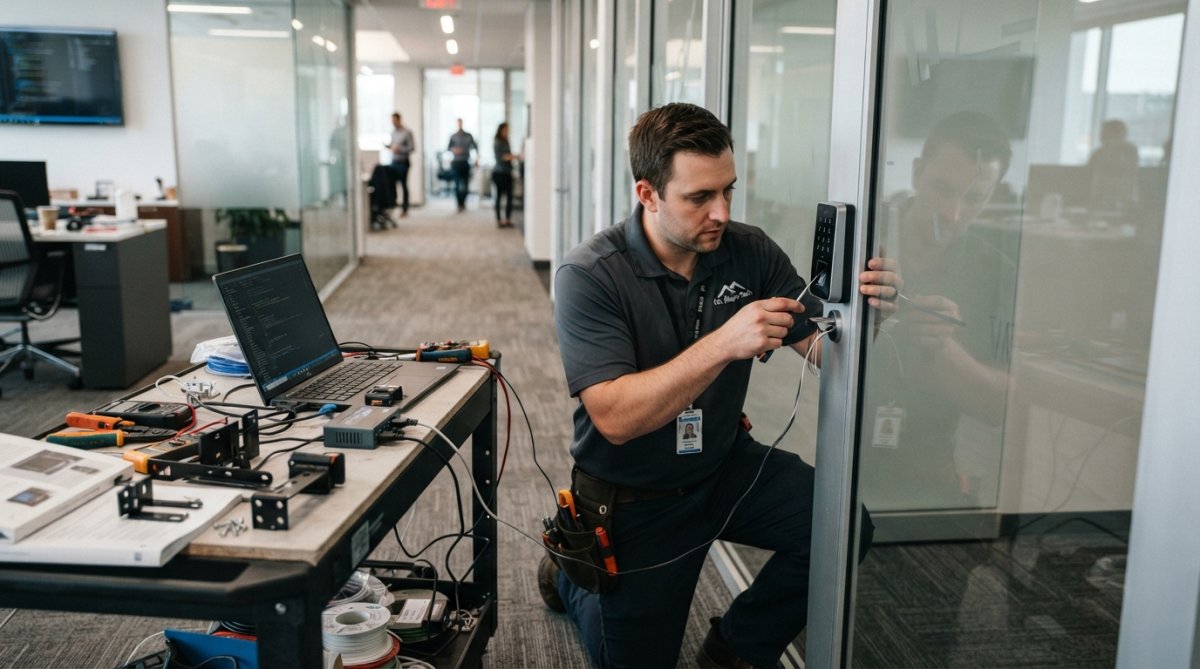
Installation and configuration phase: 4-12 weeks. This includes running cabling, mounting cameras, installing access control hardware, and configuring the centralized platform.
Testing and validation phase: 2-4 weeks. Verify that all integrations work correctly and that the centralized platform receives data from all systems.
Staff training and go-live phase: 1-2 weeks. Your security team learns to use the integrated system and troubleshoot common issues.
Total typical timeline: 12-28 weeks. A straightforward integration in a single building might take 3 months. A complex deployment across multiple buildings with legacy system replacement might take 6-7 months.
Key Benefits of Unified Security Systems
Faster threat response. Your security team sees the access event, surveillance footage, behavioral analysis, and threat assessment in one place. Response time drops from minutes to seconds.
Reduced operational complexity. Integration consolidates five separate systems into one platform, one interface, and one vendor relationship. Your team spends less time managing systems and more time responding to threats.
Better accuracy and fewer false alarms. Integration provides context, your system knows what's scheduled, who should be where, and what constitutes abnormal behavior. This dramatically reduces false alarms.
Compliance and audit trails. Integrated systems create comprehensive, tamper-proof audit trails documenting exactly who accessed which areas, when, and what they did.
Scalability. Adding a new building to an integrated system means adding components to an existing platform rather than deploying new instances of five different systems.
Cost efficiency over time. Reduced staffing requirements, fewer false alarms, faster incident resolution, and better threat prevention combine to create significant long-term value.
Privacy, Compliance, and Total Cost of Ownership
Integration concentrates video footage, access logs, biometric information, and behavioral analysis in one system, creating privacy and compliance responsibilities.
Privacy considerations. Employees have reasonable expectations they won't be recorded in bathrooms or locker rooms. Healthcare organizations must protect patient privacy. Implement privacy by design: cameras in common areas only, restricted access to footage, automatic deletion policies, and clear data access policies. For healthcare organizations, ensure your integrated system supports HIPAA-compliant access controls.
Compliance requirements. Healthcare organizations must meet HIPAA standards. Financial institutions must meet PCI DSS compliance (pcisecuritystandards.org). Manufacturing facilities with government contracts must meet NIST cybersecurity framework requirements (nist.gov). Verify that your integrated security solution supports your specific compliance requirements, including where data is stored, how it's encrypted, and what audit trails are available.
Total Cost of Ownership. Integration projects have significant upfront costs, but integrated systems typically reduce total cost of ownership compared to managing multiple isolated systems. One maintenance contract instead of five, one monitoring service, one vendor relationship. Operational efficiency gains compound over time. Evaluate total cost over 5-7 years, including direct costs (hardware, software, installation) and indirect costs (staff time, training, maintenance) alongside benefits (reduced incidents, faster response, operational efficiency).
Integrated security solutions address the fundamental challenge of modern office security: threats are sophisticated and coordinated, but your security team is finite. By connecting surveillance, access control, threat detection, and emergency response into a unified system, you transform security from reactive to proactive.
At Mt. Major Tech, we've spent years helping organizations implement integrated security solutions that protect their people and assets while simplifying operations. If you're managing fragmented security systems across multiple locations or facing challenges with false alarms and slow incident response, book online to discuss how integration could transform your security posture. We'll assess your current infrastructure, design a solution tailored to your facility and compliance requirements, and support you through every phase of deployment and beyond.
Frequently Asked Questions
What is an integrated security solution?
An integrated security solution unifies multiple security components, video surveillance, access control, alarm systems, and fire safety, into a single, centralized platform. Rather than managing separate systems from different vendors, integrated solutions allow facility managers to monitor, control, and respond to security events through one interface. This reduces operational complexity, improves incident response times, and creates a cohesive security ecosystem that protects both people and assets.
How does AI-enabled surveillance improve modern office safety?
AI-powered analytics reduce false alarms by distinguishing between genuine threats and harmless motion, such as leaves blowing or shadows. The system learns facility patterns and flags only relevant events, unauthorized access attempts, loitering in restricted areas, or perimeter breaches. This keeps security teams focused on real threats rather than wasting time investigating false positives. Real-time threat detection also enables faster incident response, often alerting personnel before a security breach fully develops.
Can integrated security systems handle facilities spread across multiple buildings?
Yes. Cloud-based integrated security platforms scale to manage distributed campuses with multiple buildings, remote locations, or branch offices. Facility managers access all sites from a single dashboard, monitor access control across all buildings, and receive unified alerts regardless of location. Local backup systems ensure that if cloud connectivity drops, on-site equipment continues to function, protecting your security footage and access logs from interruption.
How long does unified security integration take for a commercial facility?
Integration timelines depend on facility size, existing system complexity, and whether you're retrofitting legacy equipment or starting fresh. Planning and assessment take 1-2 weeks, hardware installation 2-4 weeks, and software configuration and testing another 1-2 weeks. Phased rollouts can shorten disruption, integrating one building at a time rather than the entire facility simultaneously.
What security and privacy standards do integrated systems need to meet?
Integrated security systems must comply with applicable regulations depending on your industry. Healthcare providers must meet HIPAA requirements for protecting patient privacy. All facilities handling personal data must comply with state privacy laws and, where applicable, CCPA regulations. Additionally, systems should follow NIST cybersecurity guidelines to protect against data breaches. Data encryption, role-based access controls, and audit logging ensure that surveillance footage and access records remain secure and that only authorized personnel can view sensitive information.
Can you integrate existing security equipment from different vendors?
Yes, modern integrated platforms support interoperability with hardware-software combinations from multiple vendors. Rather than replacing all existing equipment, you can often connect legacy cameras, access control systems, and alarm panels to a unified management platform. This approach reduces costs and minimizes disruption. However, compatibility depends on the specific equipment and the integration platform's capabilities. A professional security assessment will determine which existing components can be unified and which may need replacement.
What happens to security footage if the cloud service goes down?
Professional integrated security systems use hybrid storage models, recording locally to on-site servers while also backing up to the cloud. If cloud connectivity drops, local storage continues capturing footage without interruption. Once connectivity is restored, the system automatically syncs stored footage to the cloud. This redundancy ensures you never lose critical security records and maintains continuous protection even during service outages. Local backup also protects against ransomware or data loss in the cloud environment.