 ultimate-guide
Why Predictive Threat Detection Matters for Security
Table of Contents
- What Predictive Threat Detection Actually Does
- How AI-Enabled Surveillance Systems Reduce Alert Fatigue
- Predictive Risk Assessment for Businesses: Anticipating Zero-Day Attacks
- Unified Security Solutions: Connecting Prediction to Response
- Implementation Roadmap for Small and Mid-Sized Operations
- Measuring ROI and Human Oversight in Predictive Security
- Conclusion
- Frequently Asked Questions
Last Updated: September 22, 2026
What Predictive Threat Detection Actually Does
Predictive threat detection is the practice of using historical data, behavioral analysis, and machine learning algorithms to identify security threats before they become incidents. At Mt. Major Tech, we've watched this shift move from experimental to essential across commercial properties in Northern New England.
Traditional motion alerts tell you something moved. Predictive systems tell you whether that movement matters.
The difference is the difference between reacting to a break-in and preventing one. Most commercial security setups still operate on the reactive model: alarm triggers, guard responds, damage is already done. Predictive threat detection flips that sequence.
From Motion Alerts to Behavioral Analysis
A motion sensor cannot distinguish between a delivery driver and someone casing your perimeter. Both trigger the same alert.
Behavioral analysis changes the equation. The system learns what normal activity looks like at your facility, then flags deviations. A vehicle circling the parking lot three times at 2 a.m. registers differently than a car pulling into a marked delivery zone at 10 a.m.
This is where false positive reduction becomes real.
Why Historical Data Analysis Drives Accuracy
Predictive models get smarter over time because they have more data to learn from. A system that has monitored your property for six months understands your baseline. It knows when your loading dock is busy, when your offices empty out, and what your weekend traffic patterns look like.
How AI-Enabled Surveillance Systems Reduce Alert Fatigue
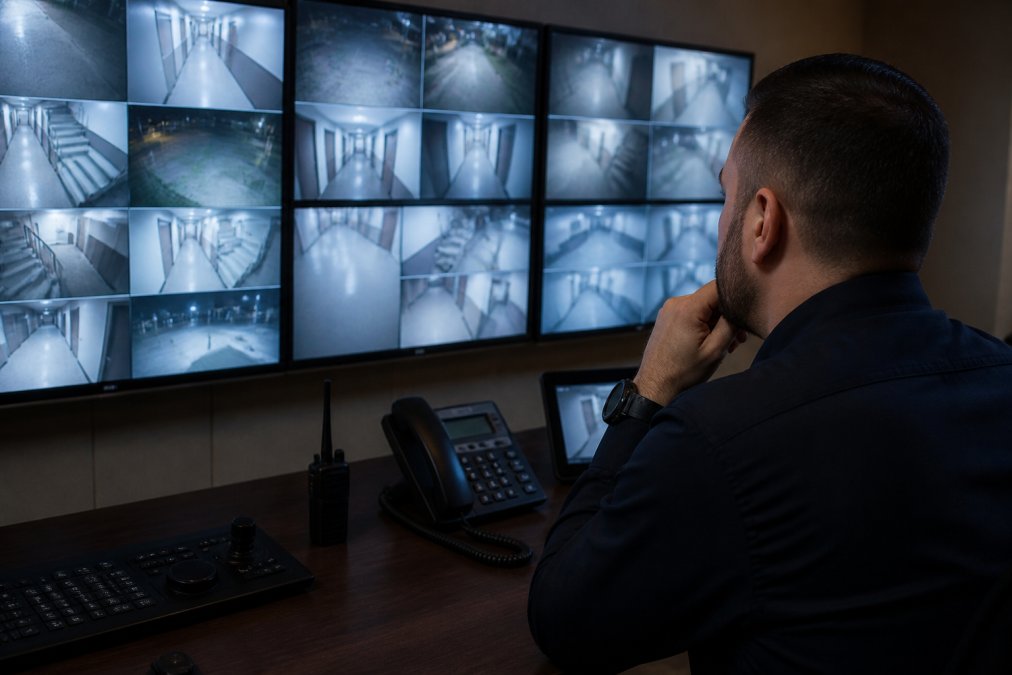
Alert fatigue is the most underrated security problem in commercial operations. When your team gets 50 alerts a day and 48 are false positives, they stop taking any of them seriously. That's when the real threat slips through.
Predictive Risk Assessment for Businesses: Anticipating Zero-Day Attacks
Zero-day attacks represent the hardest problem in security: threats that exploit vulnerabilities nobody has seen before. No signature exists. No known pattern matches. Traditional detection fails by definition. Closing these visibility gaps requires a unified defense strategy that simplifies the management of security vendor contracts across distributed environments.
The Detection Layers That Actually Catch Novel Threats
Mature predictive stacks combine several detection methods, because no single one catches everything:
- User and entity behavior analytics (UEBA). The system builds a baseline for every user, device, and service account, login times, data volumes, peer groups, geographic origin. Deviations from that baseline are scored, not just flagged.
- MITRE ATT&CK mapping. Alerts get tagged against the ATT&CK framework's tactics and techniques (initial access, persistence, lateral movement, exfiltration). This lets analysts see whether a cluster of low-severity anomalies is actually a kill chain in progress.
- Lateral movement detection. Attackers rarely strike the first machine they compromise. They pivot. Predictive systems watch for east-west traffic patterns, a workstation suddenly querying domain controllers, a service account authenticating to unfamiliar hosts, that signal pivoting before payload delivery.
- Impossible travel and credential anomaly scoring. A credential used from two locations that cannot be reached in the elapsed time is a strong signal, even when no malware signature exists.
Physical and Cyber Signals Converge
On commercial properties, the same logic applies to physical layers. A door that unlocks at an unusual hour. A credential used from an unexpected location. A camera feed that goes dark for 90 seconds without a scheduled maintenance window. These anomalies don't match any attack signature, but they signal that something deserves investigation.
The Honest Trade-Offs
Predictive systems generate more false positives on genuinely novel activity. A new employee, a changed delivery schedule, a legitimate after-hours contractor all look anomalous at first. The system learns, but the first few weeks require human patience.
Why This Matters for Zero-Days Specifically
Zero-days defeat signature matching by design. The only durable defense is behavioral: assume the attacker is already inside, and watch for the actions that follow compromise, privilege escalation, credential dumping, unusual outbound connections, rather than the exploit that opened the door. That reframing is what makes prediction useful against threats that have no known fingerprint.
Unified Security Solutions: Connecting Prediction to Response
Detection without response is just expensive monitoring. Unified security solutions connect what the system predicts to what your team actually does about it.
| Security Layer | Standalone Limitation | Unified Advantage |
|---|---|---|
| Access control | No awareness of external threats | Locks automatically when perimeter alert triggers |
| Video surveillance | Passive recording only | Focuses and records on flagged events |
| Intrusion detection | Isolated alarm, no context | Correlates with camera and access data |
| Response coordination | Manual, phone-based | Automated routing with full incident context |
Implementation Roadmap for Small and Mid-Sized Operations
Full predictive security deployment sounds expensive and complex. It doesn't have to be either. Smaller operations can phase in capability without ripping out existing infrastructure.
Phase 1: Audit and integrate (Weeks 1-4)
- Document every existing camera, sensor, and access point
- Identify which systems can feed data into a unified platform
- Confirm network capacity for cloud-based analytics
Phase 2: Establish baseline (Weeks 5-12)
- Run behavioral analysis in monitor-only mode
- Let the system learn normal activity patterns
- Review flagged anomalies weekly to tune sensitivity
Phase 3: Enable automated response (Weeks 13-16)
- Connect detection to access control and notification systems
- Define response protocols for each alert category
- Train staff on the new escalation workflow
Phase 4: Measure and refine (Ongoing)
- Track false positive rates monthly
- Adjust thresholds based on actual incident data
- Expand coverage to additional buildings as budget allows
Measuring ROI and Human Oversight in Predictive Security
Proving predictive security pays for itself requires measuring what didn't happen, which is inherently difficult. But the metrics that matter are trackable, and executives need a framework, not a slogan, before they sign off.
A Cost-Avoidance ROI Framework
Most vendors sell "reduced alert fatigue." That is a benefit, not a number. A defensible ROI model has four inputs:
- Labor recovered from false alarm reduction. If your current system generates 40 alerts a week and your team investigates all of them, cutting that to 10 saves roughly 30 staff hours weekly. Multiply by fully loaded hourly cost to get annualized savings.
- Incident cost avoidance. Industry loss data (the FBI's Internet Crime Report and the Verizon Data Breach Investigations Report are the two most cited public sources) puts the average cost of a single incident well into six figures for mid-market organizations once downtime, legal, notification, and remediation are counted. Even a modest reduction in incident frequency produces large avoided costs.
- Insurance and compliance leverage. Many commercial property and cyber liability carriers now ask about monitoring maturity during underwriting. Documented predictive monitoring can influence premiums and, in some regulated sectors, satisfies audit expectations that reactive systems do not.
- Response time compression. Faster detection shortens dwell time. Dwell time is the single strongest predictor of incident severity, the longer an attacker or intruder operates undetected, the more damage compounds.
Human-in-the-Loop Is Not Optional
Predictive models make recommendations; people make decisions. The system flags an anomaly, but a trained operator determines whether it warrants escalation. This human-in-the-loop requirement isn't a weakness of predictive security. It's what keeps the system accountable and prevents automated overreaction.
Three reasons the human layer stays:
- Accountability. Automated responses to ambiguous signals create liability. A human decision-maker creates a reviewable record.
- Context the model lacks. A model does not know a key contractor was scheduled for 2 a.m. maintenance. An operator does.
- Adversarial adaptation. Attackers probe for automated thresholds and exploit them. Human review breaks the pattern.
Data Privacy Considerations
Cloud-based analytics process footage and access data, which means the system must handle protected health information and client confidential data appropriately. Buyers should confirm how their provider manages data residency, retention, and access controls before deployment. Under frameworks like HIPAA for healthcare and state-level biometric and video privacy laws, the operator's data handling is as much a compliance question as the camera placement.
Conclusion
The gap between reactive and predictive security keeps widening. Systems that only tell you what already happened leave you responding to losses you could have prevented. Predictive threat detection gives your team the foresight to act before incidents occur, and the filtering to know which events actually deserve attention.
Frequently Asked Questions
How does predictive threat detection differ from traditional security monitoring?
Traditional monitoring triggers alerts on any motion or door contact, generating large volumes of low-value events. Predictive threat detection builds a baseline of normal activity using historical data analysis, then flags only deviations that match known threat actor patterns. This shifts security teams from reviewing everything to investigating what matters, which reduces false positive reduction pressure and shortens incident prevention timelines.
Can AI-enabled surveillance systems reduce false alarms in commercial facilities?
Yes. AI-enabled surveillance systems distinguish between people, vehicles, animals, and environmental movement before an alert fires. Machine learning algorithms trained on your site's traffic patterns filter out routine activity like staff arriving at shift change or delivery trucks at scheduled times. Facilities that deploy behavioral analysis typically see fewer nuisance alerts, which protects security team morale and keeps attention on genuine incidents.
How can businesses integrate predictive analytics into existing security infrastructure?
Most organizations do not need to replace cameras, access control, or alarms to add prediction. A unified security solutions platform can pull event data from existing hardware through open protocols, apply predictive modeling on top, and route verified alerts to your current monitoring workflow. Start with one high-traffic zone, measure alert quality for 60 to 90 days, then expand once the false positive reduction is proven.
What role does historical data play in predictive threat modeling?
Historical data analysis supplies the baseline that makes prediction possible. By reviewing 6 to 12 months of access logs, camera events, and incident reports, the system learns which activities are routine and which preceded past problems. Threat forecasting then compares live activity against that baseline, so anomaly detection reflects your actual facility rather than a generic profile.