 ultimate-guide
What Is AI-Enabled Intrusion Defense? A 2026 Guide
Table of Contents
- What Is AI-Enabled Intrusion Defense?
- Benefits of AI Intrusion Detection Systems
- How to Reduce False Alarms with AI Security
- AI-Powered Surveillance for Commercial Properties
- Adversarial AI and Model Poisoning: What to Watch For
- How to Implement AI Intrusion Defense in Your Organization
- Frequently Asked Questions
Last Updated: September 24, 2026
What Is AI-Enabled Intrusion Defense?
AI-enabled intrusion defense is the use of machine learning models to detect, classify, and respond to network and physical security threats in real time, rather than relying on fixed rules alone. At Mt. Major Tech, we deploy these systems for estates, high-rises, and regulated facilities across Northern New England, and the core idea is simple: instead of waiting for a known attack signature, the system learns what normal looks like and flags what isn't.
NIST Cybersecurity Framework guidance on detection and response
How AI-Driven Threat Detection Works
AI-driven threat detection combines signature-based detection with heuristic analysis and machine learning models that score activity in real time. The system ingests network traffic analysis data, endpoint telemetry, and access logs, then assigns each event a risk score based on how far it deviates from established patterns.
The pipeline generally runs in four stages:
- Data collection from firewalls, endpoints, cameras, and access control systems
- Feature extraction that converts raw events into measurable signals
- Model scoring that ranks each event by threat likelihood
- Automated response that quarantines, blocks, or escalates based on severity
Machine Learning and Behavioral Baselining
Behavioral baselining is the process of establishing a statistical profile of normal activity for users, devices, and networks, then measuring every new event against that profile. It is the foundation of most modern anomaly detection.
Two learning approaches dominate:
- Supervised learning trains on labeled examples of known attacks and benign activity. It performs well when you have quality labeled data and struggle with novel threats.
- Unsupervised learning clusters activity without labels, surfacing outliers that no rule would catch. It is better suited to detecting unknown threat vectors but produces more noise.
CISA guidance on continuous monitoring and threat detection
Benefits of AI Intrusion Detection Systems
The core benefit of an AI intrusion detection system is faster, more accurate detection with less manual triage. Where rule-based tools generate alerts on every deviation, AI models weigh context, history, and correlation before escalating.
Key advantages:
- Proactive rather than reactive posture. Threats are flagged during early-stage reconnaissance, not after data exfiltration begins.
- Improved cybersecurity posture through continuous predictive analytics on user and device behavior.
- Faster incident mitigation because the system can trigger automated remediation such as isolating a compromised endpoint.
- Reduced alert fatigue when false positives are tuned properly, which preserves analyst attention for real incidents.
How to Reduce False Alarms with AI Security
A practical approach:
- Run a learning period. Let the system observe for several weeks before enforcing automated responses.
- Whitelist known-good behavior such as scheduled backups, badge-in patterns, and maintenance windows.
- Correlate across sources. A single unusual login is noise. An unusual login plus unusual data access plus an unusual time is a signal.
- Review and retrain quarterly. Attackers adapt; your baseline should too.
The payoff is measurable in team morale. A security operations center that stops chasing phantom alerts can focus on automated threat hunting and genuine incident response.
AI-Powered Surveillance for Commercial Properties
AI-powered surveillance for commercial properties extends intrusion defense beyond the network into the physical layer. Cameras with on-edge analytics classify objects, track movement across zones, and flag behavior that matches a threat profile, all without a human watching every feed.
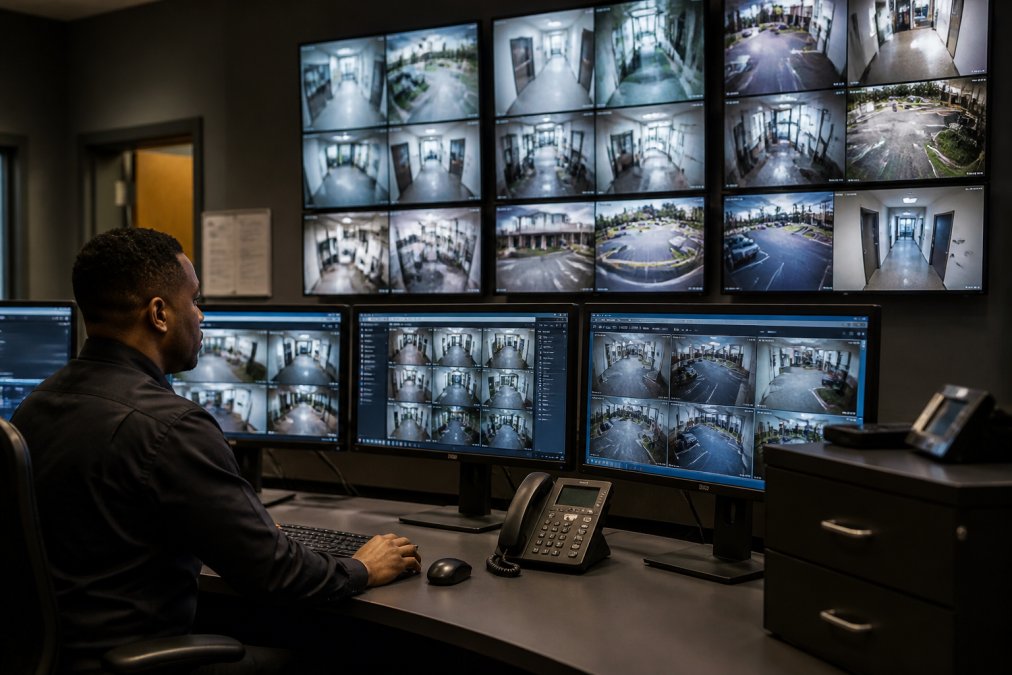
What the analytics layer actually does
Most commercial deployments run four detection classes on the edge, meaning the inference happens on the camera or a local appliance rather than in the cloud:
- Object classification, distinguishing a person, vehicle, animal, or package from background motion. This is what suppresses the tree-branch and headlight alerts that plague motion-only cameras.
- Loitering and dwell-time detection, flagging when a person remains in a zone longer than a configured threshold, which is the single most useful signal for perimeter and parking-structure coverage.
- Line-crossing and directional detection, counting entries and exits across a virtual tripwire, useful for after-hours access to loading docks and restricted corridors.
- License plate and facial recognition, the highest-value and highest-risk class. Both are biometric technologies, and several states and localities restrict or prohibit their use in commercial settings. Confirm your jurisdiction's rules before enabling either.
Integration is the actual product
For distributed campuses and multi-building facilities, the practical questions are integration and scale. A cloud-based platform can aggregate feeds from dozens of sites into one view, while local storage provides a fallback if connectivity drops. The best deployments combine both: cloud analytics for correlation and on-premises recording for continuity.
Retention, privacy, and evidence handling
AI surveillance generates more usable evidence than analog systems, which raises the stakes on retention policy. A common pattern is 30 days of continuous recording with longer retention for flagged events, but the right window depends on your legal exposure and storage budget. Two practical controls:
- Role-based access to footage, with audit logs showing who viewed what and when. Footage of employees and visitors is sensitive, and insider misuse is a real risk.
- Documented chain of custody for any clip that may become evidence. If an incident goes to litigation or a criminal referral, an undocumented export can be challenged.
FBI guidance on physical security and threat awareness
Adversarial AI and Model Poisoning: What to Watch For
Adversarial machine learning is the practice of manipulating AI models by feeding them crafted inputs or poisoned training data, and it is the threat most vendors underplay. An attacker who understands your model can often bypass it without ever tripping an alert.
Two attack patterns dominate:
- Evasion attacks craft inputs that the model misclassifies as benign, such as slightly altered malware or a subtly disguised intrusion pattern.
- Model poisoning corrupts the training data so the model learns the wrong baseline, effectively blinding it to a specific threat.
Ask any AI security vendor how their model is retrained and who validates the training data. The answer separates a serious deployment from a marketing demo. Models that retrain automatically from live traffic without validation are the easiest to poison.
How to Implement AI Intrusion Defense in Your Organization
Implementation succeeds when it is staged, scoped, and tied to a specific outcome. Rolling out AI intrusion defense across an entire organization at once is the most common way these projects fail. The roadmap below is written for small and mid-sized operations that do not have a dedicated detection engineering team.
A workable roadmap:
| Phase | Focus | Typical Duration | Key Deliverable |
|---|---|---|---|
| 1. Assess | Inventory assets, map attack surface | 2-4 weeks | Asset and risk register |
| 2. Baseline | Deploy monitoring, observe behavior | 4-8 weeks | Tuned baseline model |
| 3. Pilot | Enable detection on one segment | 4-6 weeks | Validated detection rate |
| 4. Expand | Roll out across sites, integrate legacy systems | 2-4 months | Unified monitoring view |
| 5. Maintain | Retrain, red-team, review alerts | Ongoing | Quarterly model review |
The SMB version of this roadmap
The enterprise version of each phase assumes staff you probably do not have. A realistic small-business adaptation:
- Scope to one crown jewel first. Pick the system whose compromise would actually hurt, the billing server, the point-of-sale network, the building management system, and instrument that before anything else. Broad-and-shallow deployments generate noise without insight.
- Buy the tuning, not just the tool. The licensing cost is rarely the problem; the ongoing analyst time is. If you cannot staff a security operations function, contract for managed detection and response rather than buying a platform you will not tune.
- Set an explicit false-positive budget. Decide in advance how many alerts per day your team can genuinely investigate, for most small teams, that is a handful, and hold the vendor to it. Alert fatigue is the number-one reason AI detection projects get switched off.
- Name one accountable owner. Even a part-time internal owner who reviews the weekly alert summary and approves baseline changes keeps the system honest.
Integration with legacy infrastructure
This is where most timelines slip. Older cameras, access panels, alarm systems, and network gear often lack modern APIs, so the integration layer has to bridge protocols. Practical approaches, in rough order of preference:
- Native API or syslog export, cleanest, but only available on newer equipment.
- Protocol translation gateway, a device or software layer that converts legacy serial, dry-contact, or proprietary formats into a common event stream.
- Agent-based collection, installing a lightweight agent on servers and endpoints to feed telemetry directly, bypassing the network gear entirely.
- Manual or scheduled log export, a fallback for systems that cannot stream, acceptable for low-value assets but not for anything time-sensitive.
Managing false positives after go-live
Tuning is not a one-time task. A practical cadence that most teams can sustain:
- Weekly: review the top alert sources and suppress or whitelist confirmed benign patterns.
- Monthly: review detection coverage against any new assets or applications added to the environment.
- Quarterly: retrain or re-baseline, and re-test the model against a known attack simulation.
Skipping the learning period is the fastest way to destroy trust in a new system. If you enforce automated blocking on day one, legitimate staff get locked out, the security team loses confidence in the tool, and the project stalls before it delivers value.
What does AI-enabled intrusion defense cost?
Pricing depends on the number of sites, camera count, integration complexity, and whether you need cloud analytics, local storage, or both. Because every deployment is scoped differently, the only accurate figure comes from a site assessment. Mt. Major Tech provides quotes after reviewing your existing infrastructure and coverage requirements.
Frequently Asked Questions
How does AI work in intrusion detection?
AI uses machine learning to analyze network traffic, user behavior, and physical sensor data. It establishes a baseline of normal activity, then flags anomalies that could indicate a threat. Unlike signature-based detection that relies on known attack patterns, AI can identify zero-day vulnerabilities and new threat vectors by recognizing deviations from normal behavior. This enables real-time monitoring and automated response, reducing the time between detection and incident mitigation.
Can AI-enabled intrusion defense reduce false alarms?
Yes. Traditional motion sensors trigger on any movement, but AI-powered systems use behavioral baselining and heuristic analysis to distinguish between routine activities and genuine threats. For example, AI can ignore a janitor's after-hours cleaning routine but alert on an unauthorized entry. This reduces false positive rates significantly, easing alert fatigue for security teams. Many commercial properties report fewer nuisance alarms and better focus on real incidents after deploying AI-enabled intrusion defense.
Is AI-enabled intrusion defense suitable for residential properties?
AI-enabled intrusion defense works for homes as well as businesses. For residential estates, it can integrate with smart cameras, doorbell sensors, and access control to provide proactive protection. Homeowners benefit from fewer false alarms, remote monitoring via mobile apps, and automated responses like locking doors or turning on lights when unusual activity is detected. The system scales to fit single-family homes or multi-building properties.
What role does machine learning play in threat detection?
Machine learning trains models on historical data to recognize patterns associated with attacks. Supervised learning uses labeled examples of known threats, while unsupervised learning identifies new anomalies without labels. Over time, the model improves at predicting and classifying threats, enabling automated threat hunting and predictive analytics. This continuous learning helps security systems adapt to evolving attack surfaces and maintain a strong cybersecurity posture.