 ultimate-guide
Security System Requirements for Healthcare Facilities
Table of Contents
- Why Healthcare Facilities Need Integrated Security Systems
- HIPAA Compliance for Security Systems
- Hospital Access Control Best Practices
- AI-Enabled Surveillance for Healthcare
- Unified Platform Integration and Scalability
- Emergency Response and Lockdown Procedures
- Budgeting and ROI for Healthcare Security Systems
- Frequently Asked Questions
Last Updated: August 28, 2026
Why Healthcare Facilities Need Integrated Security Systems
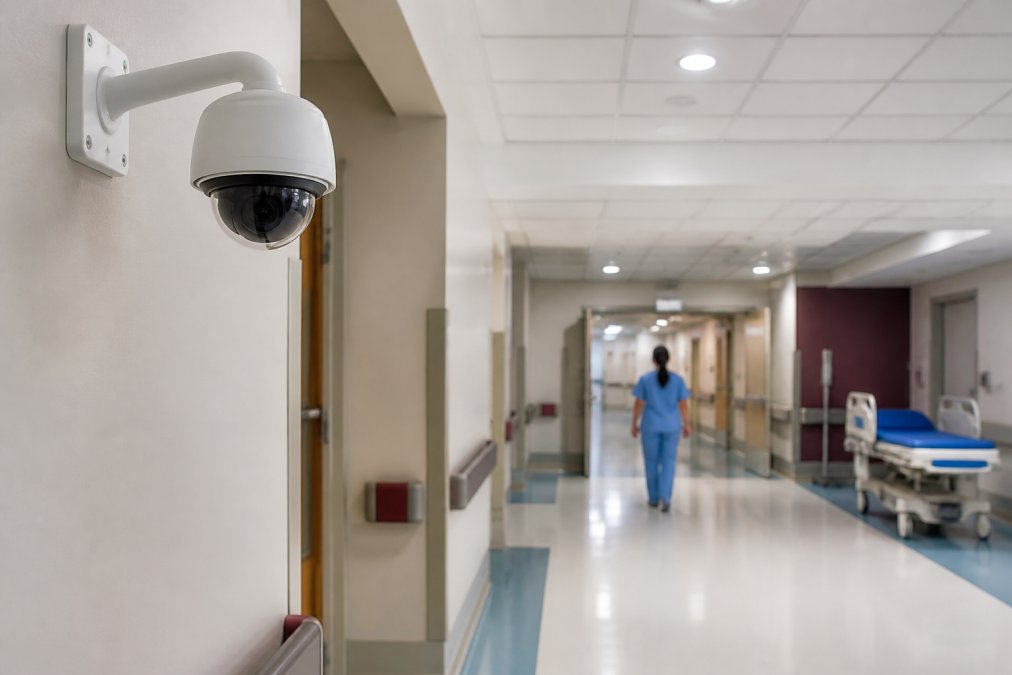
Healthcare security is foundational. Hospitals, clinics, and medical offices handle sensitive information and vulnerable populations. A breach, physical or digital, puts lives at risk.
Most facilities face fragmentation: access control from one vendor, surveillance from another, alarms from a third. When a security incident occurs, your team scrambles across multiple platforms to piece together what happened. Critical minutes pass.
Integrated security systems consolidate physical security infrastructure, data protection protocols, and incident response into a single platform. The result: faster threat detection, clearer compliance documentation, and effective staff response. Access control feeds directly into surveillance. Audit trails generate automatically. Emergency lockdown becomes instantaneous instead of manual.
HIPAA Compliance for Security Systems
HIPAA compliance is a legal and ethical mandate. The Health Insurance Portability and Accountability Act requires administrative, physical, and technical safeguards to protect Protected Health Information. Your security system must align with all three pillars.
A truly integrated platform addresses all three simultaneously, documenting that the right people had access at the right time for the right reasons.
Protecting Protected Health Information (PHI)
Protected Health Information is any patient data that could identify an individual: names, medical record numbers, dates of birth, social security numbers, insurance information. Under HIPAA, you must prevent unauthorized access and prove you did so.
Your system must include technical controls that make unauthorized access difficult: encryption at rest and in transit, role-based access control, and multi-factor authentication, something you have (a badge), something you know (a PIN), something you are (a fingerprint or iris scan). Patient information stored on servers should be encrypted using current cryptographic standards. Video footage containing patient information should be encrypted. If your system stores data in the cloud, your provider must maintain encryption and demonstrate HIPAA Business Associate Agreement compliance.
Audit Trails and Compliance Reporting
Audit trails are your proof. They document every access event: who accessed what, when, what they did, and whether access was authorized. For physical security, this means every badge swipe and biometric authentication logged with a timestamp. For digital security, every login and file access is recorded. For surveillance, every feed is timestamped with integrity verification.
Fragmented systems don't generate cohesive audit trails. A unified platform generates integrated audit trails automatically with synchronized timestamps. When you need to investigate, you pull one report. When demonstrating HIPAA compliance to regulators, you have comprehensive documentation showing your security infrastructure functioned as designed.
Hospital Access Control Best Practices
Access control is the first line of defense. It determines who enters your facility, which areas they access, and when. Modern healthcare access control requires identity verification beyond badges, which can be lost or stolen. Biometric authentication combined with a badge creates two-factor authentication that's both secure and frictionless for staff.
Access control should be granular. A lab technician doesn't need access to the psychiatric ward. A visitor doesn't need access to medication storage. Role-based access control automatically grants appropriate permissions based on job function, department, and clearance level, reducing attack surface.
Biometric Authentication and Credentialing
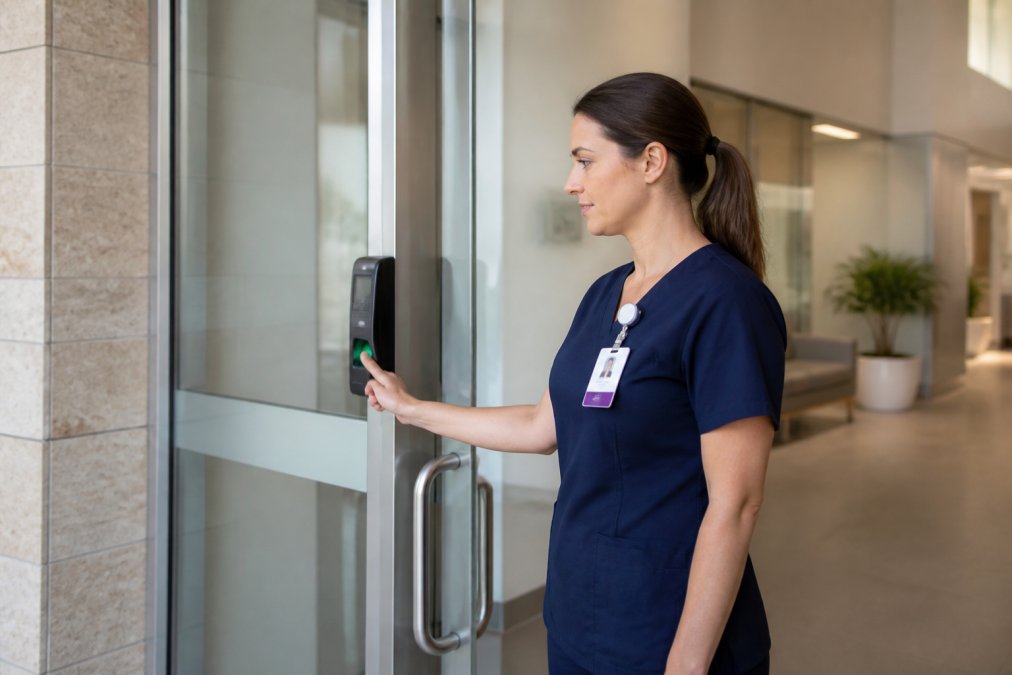
Biometric authentication uses physical characteristics, fingerprints, iris patterns, facial geometry, to verify identity. Unlike passwords or PINs, biometric data cannot be forgotten, shared, or easily replicated.
Fingerprint recognition is the most established technology. It's fast, reliable, and cost-effective. Most staff authenticate in under two seconds with low false rejection rates. Iris and facial recognition offer additional security layers. Your biometric system should feed directly into access control and audit trail systems. When someone authenticates with their fingerprint, that event logs their identity, location, timestamp, and authorization result, creating an unbreakable link between person and access event.
Credentialing verifies that someone is authorized to perform their role, including verifying licenses, certifications, background checks, and training completion. Your access control system should integrate with credentialing so that when credentials expire or are revoked, access automatically restricts.
Visitor Management and Check-In Protocols
Visitors represent a security challenge. A formal visitor management system creates controlled access. Visitors check in at a central location, verify identity against government-issued ID, confirm visit purpose, and receive temporary credentials granting access only to needed areas for the visit duration.
The visitor management system should integrate with access control and surveillance. When a visitor's badge accesses a door, that event logs. If they attempt unauthorized area access, the system denies access and logs the attempt. When the visit expires, the temporary credential automatically deactivates.
AI-Enabled Surveillance for Healthcare
Traditional surveillance is reactive. By the time you review footage, the incident is over. AI-enabled surveillance changes this. Computer vision systems analyze video in real time, detecting threats before escalation: erratic behavior in waiting areas, unauthorized restricted area access, unusual medication storage room activity. The system flags these immediately, allowing your security team to respond while the situation is developing.
Real-Time Monitoring and Video Analytics
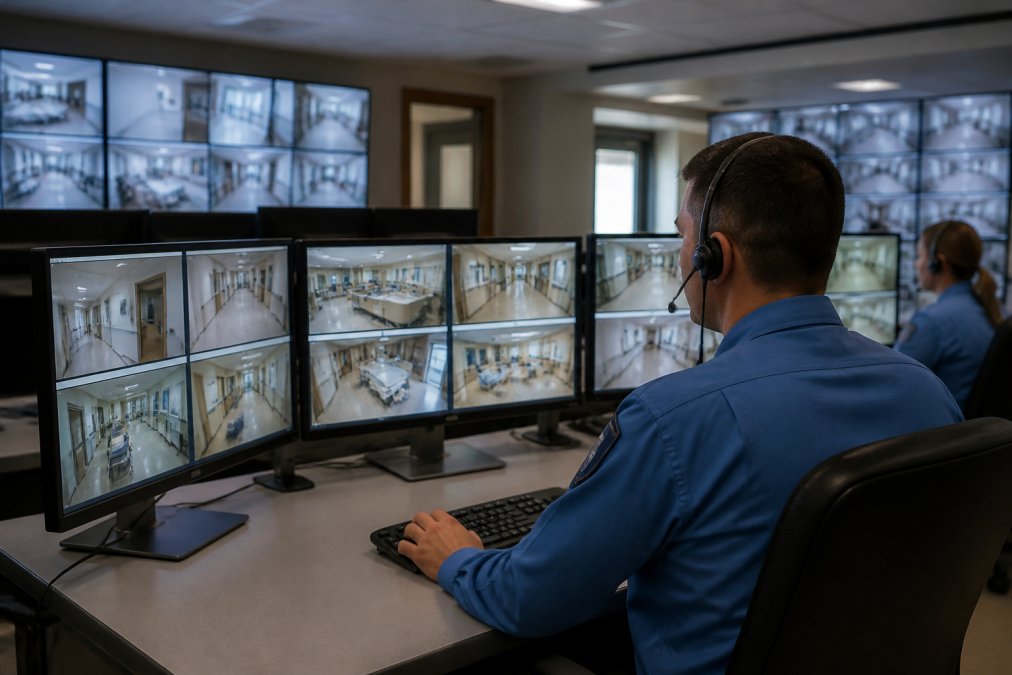
Real-time monitoring means your security team sees what's happening across your facility now, not hours later. Video feeds from key areas stream to a central monitoring station.
Video analytics add intelligence. Instead of expecting operators to watch dozens of screens and catch every anomaly, the system watches for you. It detects unusual movement patterns, loitering in restricted areas, and unauthorized door access attempts. Integration with access control amplifies this. When someone attempts unauthorized door access, the system automatically triggers video recording and alerts security staff.
Reducing False Alarms and Security Fatigue
A common complaint is false alarms. Motion sensors trigger from any movement. Door sensors trigger from legitimate door propping. Alarm fatigue sets in. Staff stops taking alarms seriously.
AI-enabled surveillance reduces false alarms dramatically. Traditional motion sensors detect any movement. AI systems understand context, distinguishing intentional person movement from curtains blowing. Analytics should learn from your facility's patterns, adjusting sensitivity accordingly while maintaining threat detection.
Unified Platform Integration and Scalability
Fragmented security systems create operational chaos. Your access control team uses one interface. Your surveillance team uses another. Your alarm team uses a third. Information doesn't flow between systems.
A unified platform consolidates all security functions into a single system: access control, surveillance, alarms, visitor management, emergency notification. All use the same database. All generate synchronized audit trails. All accessible from a single interface. Your security team logs in once and sees everything. Incident response becomes faster because information flows automatically.
Consolidating Multiple Security Systems
Most healthcare facilities have built security infrastructure over years with legacy systems from multiple vendors. A modern integration platform can connect existing systems and create a unified interface. Your legacy access control continues managing doors. Your legacy surveillance continues recording. A central platform aggregates data from all systems and presents it through a single interface.
Over time, as systems reach end-of-life, you replace them with integrated solutions. Eventually, you have a truly unified platform where all components are designed to work together.
Cloud-Based Storage with Local Backup Options
Video surveillance generates massive data. A single camera recording continuously generates terabytes per year. Local storage alone becomes impractical.
Cloud-based storage solves capacity problems. Your footage stores on secure, redundant servers in healthcare-compliant data centers. A hybrid approach provides the best solution. Primary footage stores in the cloud for capacity and redundancy. Recent footage and footage from critical areas also stores locally. If your cloud connection fails, you still access recent footage. Once restored, the system automatically synchronizes.
Emergency Response and Lockdown Procedures
When a security threat emerges, your facility needs instant, decisive response. An integrated security platform supports this. The moment a threat is detected, through surveillance analytics, access control alerts, or manual reporting, the system initiates lockdown. All doors in the affected area automatically lock. All staff receive immediate notification. All security personnel receive alerts with location and threat details.
Lockdown should be granular. You don't lock down your entire facility for a threat in one area. You lock down the affected zone while allowing safe movement elsewhere. Staff notification is critical. Every staff member should receive immediate notification through phones, overhead announcements, and desktop alerts.
Emergency response procedures should be regularly tested and documented. Lockdown drills should occur quarterly. Integration with local law enforcement is important. When you call 911, your security system should automatically provide responding officers with building layouts, camera feeds, access points, and real-time threat location if known.
Budgeting and ROI for Healthcare Security Systems
Healthcare administrators need to justify security investments in terms that resonate with CFOs and boards. Start with current spending: access control contracts, surveillance contracts, alarm monitoring contracts, IT support for multiple platforms, staff time managing multiple systems.
Next, calculate risk exposure. What's the cost of a data breach? HIPAA violations can result in fines up to $1.5 million per violation category. What's the cost of a security incident harming patients or staff? What's the cost of system downtime?
A unified security system reduces risk exposure through better detection and faster response. It protects from compliance violations through comprehensive audit trails. It reduces operational costs through consolidation. Many healthcare facilities find that cost savings from consolidation, eliminating redundant contracts, reducing IT overhead, improving staff efficiency, can contribute to the return on investment for a new system.
Healthcare security is too important to leave to chance. Your facility needs an integrated security system consolidating access control, surveillance, emergency response, and compliance reporting into a single, reliable platform.
Mt. Major Tech specializes in designing and implementing unified security systems for healthcare providers across Northern New England. We understand HIPAA compliance requirements, operational challenges of managing multiple buildings and departments, and that your security team needs systems that work reliably.
HIPAA Security Rule requirements from the Department of Health and Human Services form the foundation of healthcare security compliance. NIST Cybersecurity Framework guidance provides additional best practices. The American Hospital Association's security recommendations address facility-specific considerations.
Our integrated approach combines physical security (access control, surveillance, emergency response) with digital security (data encryption, audit trails, compliance reporting) into a cohesive system designed for healthcare environments.
Book online with Mt. Major Tech to discuss your healthcare facility's security requirements and discover how a unified platform can improve your security posture while reducing operational costs.
| Security Function | Fragmented Approach | Unified Platform |
|---|---|---|
| Access Control | Separate vendor and interface | Integrated with surveillance and audit trails |
| Surveillance | Separate vendor and interface | Real-time analytics and integrated storage |
| Emergency Response | Manual coordination across systems | Automated lockdown and staff notification |
| Audit Trails | Separate logs from each system | Integrated, synchronized documentation |
| Compliance Reporting | Manual assembly of data | Automated comprehensive reports |
| Staff Training | Multiple system interfaces | Single unified interface |
Frequently Asked Questions
Q: What are the key HIPAA security standards required for healthcare facility systems?
A: HIPAA mandates that healthcare facilities implement administrative, physical, and technical safeguards to protect Protected Health Information. Your security system must include access controls with unique user identification, encryption of data in transit and at rest, audit trails documenting all access to PHI, and regular risk assessments. The Security Rule requires that only authorized personnel can access patient data, and your system must support role-based access control to enforce this principle. Compliance also demands that you maintain comprehensive logs of who accessed what information and when.
Q: How does AI-enabled surveillance reduce false alarms in healthcare environments?
A: AI-enabled surveillance uses advanced video analytics to distinguish between genuine threats and routine activity, such as staff movement, equipment shifts, or environmental changes. Traditional motion sensors trigger alarms for any movement, creating alert fatigue that exhausts security teams and undermines response effectiveness. AI systems learn your facility's normal patterns and only alert on unusual behavior: unauthorized access attempts, prolonged presence in restricted areas, or suspicious package placement. This dramatically reduces false alarms while improving detection of actual security incidents, allowing your security team to focus on genuine threats.
Q: Can a unified security platform integrate existing cameras, access control, and alarm systems?
A: Yes, modern unified platforms are designed to integrate multiple security systems into a single interface without requiring complete replacement of existing equipment. Integration depends on your current systems' compatibility and whether they support standard protocols like IP connectivity. A unified approach consolidates video surveillance, access control, and incident response into one dashboard, reducing operational complexity and improving response times. However, older proprietary systems may require upgrades or replacement of specific components. A security consultant can assess your existing infrastructure and determine what can be integrated and what needs updating.
Q: What should healthcare facilities budget for integrated security systems?
A: Healthcare security system costs vary significantly based on facility size, number of access points, camera count, compliance requirements, and whether you're integrating existing equipment or building from scratch. Budgeting should account for initial hardware and installation, software licensing, cloud storage or local backup infrastructure, ongoing monitoring and maintenance, staff training, and compliance reporting tools. ROI typically comes from reduced security incidents, lower insurance premiums, faster emergency response, decreased staff turnover from improved safety, and operational efficiency gains from unified monitoring. Contact a security integrator for a detailed assessment of your specific facility needs and budget requirements.